


Night-Time Sleepover Supports are a vital service provided to NDIS participants who require a baseline of 24/7 support. It involves a support worker staying overnight at the participant’s home, or in a supported accommodation setting, to provide help as needed.
Whether you are a provider, an NDIS participant, or a support worker, understanding the latest NDIS sleepover rules is essential for maintaining safety, compliance, and fair compensation.What Constitutes a Night-Time Sleepover Shift?
During a sleepover shift, a support worker is essentially 'on call'. They may assist with evening routines, such as preparing meals or getting the participant ready for bed, and are available to help with nighttime tasks like toileting, medication management, or unexpected emergencies. Crucially, the support worker is permitted to sleep when their active assistance is not required.
Under the NDIS Pricing Arrangements and Price Limits (PAPL) and the SCHADS Award, a Night-Time Sleepover Support must meet the following conditions:
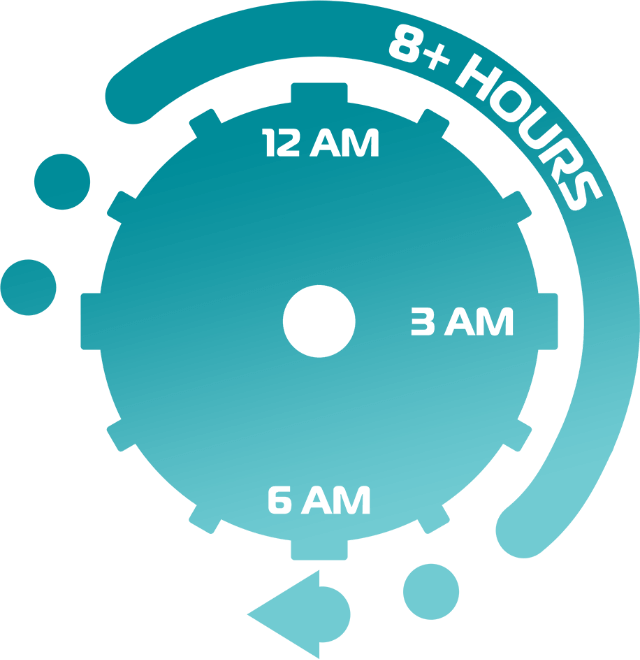
- Timeframe: The shift must commence before midnight (12:00 am) and finish after midnight on the following day.
- Duration: The sleepover must be for a continuous period of at least 8 hours.
- Continuous Shift: A sleepover, along with the hours worked immediately before or after the sleepover period, is counted as one continuous shift.
NDIS Sleepover Rules: Payment and Active Support
Sleepover supports are price-limited, meaning the NDIS caps the maximum amount they will pay per sleepover. Sleepovers are paid at a flat rate rather than an hourly rate.
Active Support Allowances:
The flat rate for an NDIS sleepover shift includes up to a maximum of two hours of active support provided to the participant during the 8-hour period.
- If a worker is woken up to perform work during the sleepover, the SCHADS Award dictates they are paid at the prescribed overtime rate for a minimum of one hour.
- If the active work exceeds one hour, workers are paid the prescribed overtime rate for the entire duration of the work.
- Providers may claim for a third or additional hour at Saturday rates on weekdays, or at applicable penalty rates on weekends and public holidays.
NDIS Rates / Line Items
| Line Item Number | Support Name |
| 01_010_0107_1_1 | Assistance With Self-Care Activities - Night-Time Sleepover |
| 01_206_0115_1_1 | Short Term Accommodation - Sleepover |
| 01_832_0115_1_1 | Assistance in Supported Independent Living - Night-Time Sleepover |
NB: There is not such a thing as NDIS rate that has to be paid. The price given in NDIS Pricing Arrangements is the maximum that can be charged. However, this does not mean that you have to charge at this rate. In fact, it is usually wise to charge less - a lot of providers do this in order to get more work.
Managing Disruptions and Changing Needs
It is critical not to confuse sleepover shifts with active overnight supports. Active overnight supports are funded for participants who require a worker to be awake and working for normal sleeping hours (more than two hours per night).
If a participant experiences unexpected changes in their sleeping patterns and regularly requires more than two hours of active support, providers must act. The NDIS sleepover rules suggest working with an occupational therapist to review the participant's needs. The provider should then contact the National Disability Insurance Agency (NDIA) to discuss modifying the participant's Supported Independent Living (SIL) funding to accommodate active night supports.
Advance Payments for Night-time sleepover
An advance payment is made ahead of time - paying for a service before you receive it. NDIS does not pay for support services in advance.
iPlanManagers prioritise claiming payments on the day providers submit their invoices (before 3 pm) and will provide payment on the next working day. In general, when a provider is getting their payments in a timely manner after invoicing, they would not ask for a payment in advance.
Invoice Example
Simple Invoice
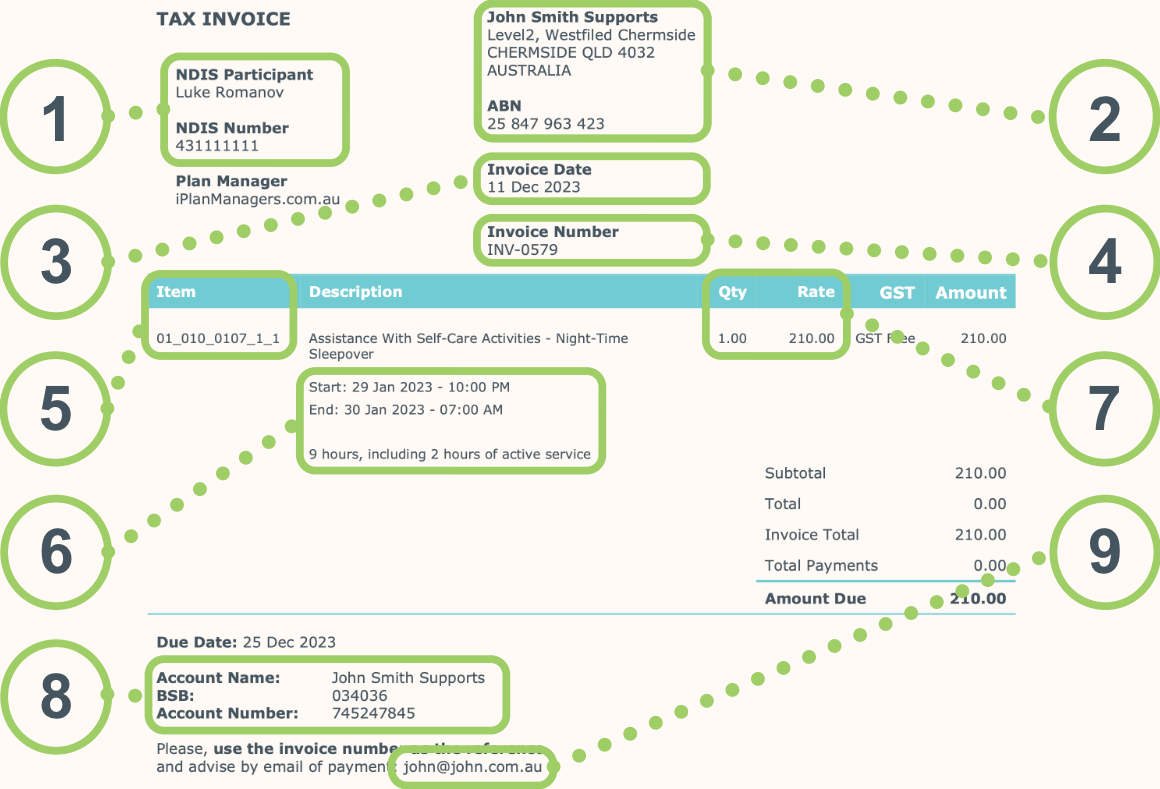
NDIS invoice requirements (cleaning invoice example):
- NDIS participant’s Name and NDIS number
- Business Name and valid ABN for the business
- Invoice Date
- Unique invoice number
- NDIS line item number
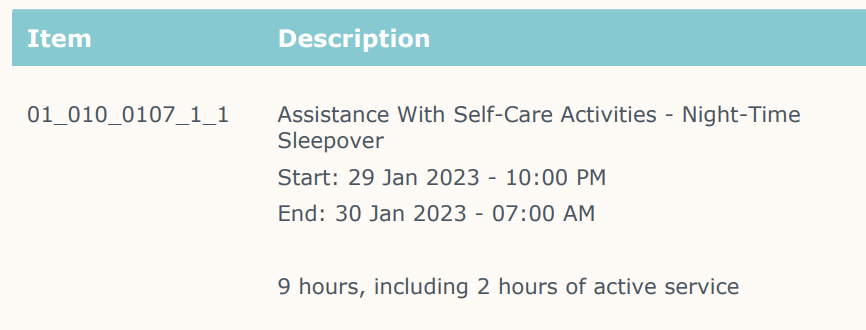
- Start time and date of the support, end time and date of the support.
- The rate at which you are charging for night-time sleepover
- Bank Account Details for prompt payment
- Email address where to send remittance advice and/or additional questions
Workplace Health and Safety (WHS) Obligations
Providers and NDIS participants who engage their own workers have strict duties under the NDIS Code of Conduct to ensure a safe working environment. This includes:
- Behaviour Support Plans: If a participant has complex behaviour support needs during the night, workers must follow a proactive, evidence-informed Behaviour Support Plan. If the plan is ineffective at night, the provider must flag this with the NDIS behaviour support practitioner.
- Safe Environments: Providers must have procedures that offer a stable environment, identify environmental risk factors, and adequately train staff on night-time protocols.
- Worker Fatigue: Ensuring that sleepover shifts are managed in accordance with Fair Work and WHS guidelines to minimize the risk of worker fatigue.